"Why I Am a UU Humanist", by Mehl Renner
Editor's note: this is an entry in a series of essays on this topic. Please, share your story.

FREEDOM DEPENDS ON FREETHINKERS!

My title likely comes from a bumper sticker and I borrow it because I have such a strong belief in the concept of freedom. That certainly includes the freedom to be an atheist! I am Vietnam veteran and did not serve my country so I would be required to believe in God. We are NOT a country “Under God”, but rather under a constitution that gives us the freedom to believe or not believe as we choose. The best thing to have faith in is yourself!

My mother raised my two sisters and me as a Baptist to expose us properly to being churched in the South. My dad was in the beer business and that was rather frowned upon. He was once the Plant Manager of the Budweiser Brewery in St. Louis. I think he was always a hard core atheist and I later embraced that as well. I believe it began to happen for me when I entered college, because it was then that I really started doing more genuine thinking. In later years my dad and I both loved the thinking of Sam Harris and Richard Dawkins and all the principles of Humanism. We had no regard for most religions, but were both approached to become charter members of a Unitarian Universalist church. Most of the charter members were gay and were turned away by local churches. That was just not right. I liked the idea of seeking truth on your own terms and in my mind constantly redefining by reason my spiritual equation to live by. So about 20 years ago my dad and I became charter members of the Georgia Mountains UU Church located in Dahlonega, GA. We both were featured speakers at services and really tried to convey the need for more of a “habitat of humanism” rather than a “house of worship”. To worship anything is to enslave the mind.
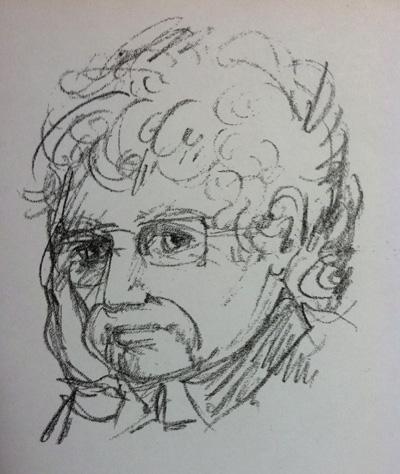
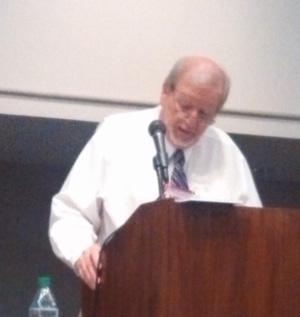
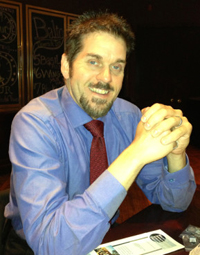
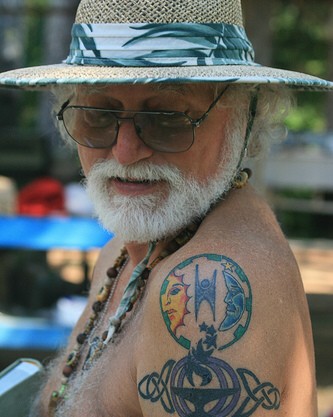
Fourteen years ago I moved to Charlotte and became a member of the Piedmont UU Church. There I met my significant other, Gail, at a church coffee house event. [Editor's note: that's Gail's portrait of Mehl on the right. The one above was taken at the Burning Man Festival.] She is a woman who claims to be a druid, with a similar distaste for fundamental Christian belief. She tends to be more spiritual and that is okay. There is book written by a highly respected French author titled “The Little Book of Atheist Spirituality”. A humanistic perspective is that God is within us and not a super natural power over and above us. In other words, we are God. We need to be far more concerned about our planet in order to be one with the earth. Similar to the message conveyed in the pantheistic message of the movie “Avatar”. I mention the UU church I am a member of here in Charlotte because a couple of years ago I was nominated and became president of this congregation in spite of my well known standing as an atheist. This says a lot about the tolerance of that denomination and demonstrates how members truly have the freedom to seek what is truth for them without being subjected to the traditional dogma for most churches.

I am extremely proud to be a freethinker and free to be an atheist!

Mehl W. Renner – Charlotte, North Carolina
 

"Why I Am a UU Humanist", by Brian Lofgren

Editor's note: this is the first in a series of essays on this topic. Please, share your story.

Why I Am a UU Humanist

In my case, it took thirty-nine years to arrive as a Unitarian Universalist (UU) Humanist. I’m writing this essay just nine years beyond that memorable crossroad. I was raised in Christian culture. Like my Methodist parents and grandparents, I was conditioned from childhood to suspend critical thinking where religion was concerned, and just believe. This message was reinforced in the Lutheran school I attended from fourth, through eighth grade.

The popular God, the “Everything-God”, was the 'face' that personified not only the known, but the vast unknown. Religious systems may help followers meet some of their emotional, psychological, and social needs. However, readily accepting mythical-sounding stories as fact came at a cost.

I returned from South America in 2003, after five years as a Catholic “missioner”. I was in the throws of a cultural and religious transition that would last at least four more years. Furthermore, my wife and I had considerably downsized our economic footprint; we were starting over.

The five years of social justice work had brought me up to speed on the workings of Patriarchy, Hierarchy, systemic injustice, and the need for social, and environmental responsibility. During those reflective years, I had reevaluated my Methodist and Lutheran upbringing, my adopted Catholicism, and many other traditional, religious systems. Through a journey of book research and timely conversations, I slowly transitioned to a broader, more natural world view.

Soon after gaining easy, stateside access to the Internet, I stumbled across the religious debates and books of Christopher Hitchens, Sam Harris, and Richard Dawkins. The candor of their presentations, and the pointedness of their factual evidence ruptured my remaining bubble of contextual ignorance. In the aftershocks, I went through a period of emotional turbulence, and a sense of alarmed urgency.

Some friends and family members graciously responded to my long, sometimes agitated email conversations regarding various aspects of opposing world views. During that difficult transition period, I poured my thoughts into one of my web pages titled, “Toward Secular, Religious Harmony”. I’ll probably place a copy of this essay there, among my earlier musings.

After receiving a graduate degree in May of 2006, I was introduced to The Virtues Project. I had some poignant conversations with the projects’ founders and two of its instructors. I created over sixty illustrations for the Project, portraying examples of socially responsible behavior. I latched onto this idea of universal, healthy behavior. I was looking to bridge the gap between my past and present sense of self. I wished to connect with people dear to me on either side of the personal chasm I had crossed. Ethical virtues, and the UU Principles symbolized common ground. These were ideas I could embrace. I didn’t want to be fooled again.

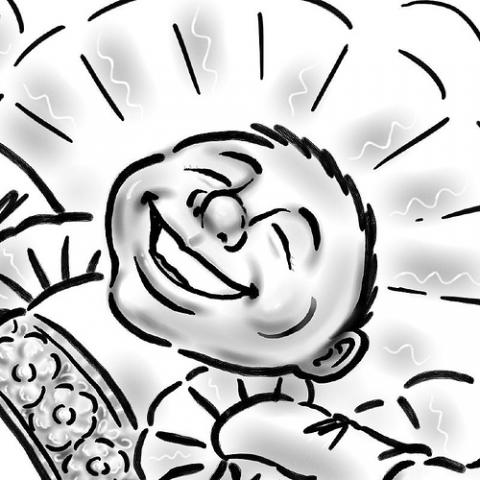
Throughout the summer and autumn of 2007, I worked compulsively, meticulously, to write, illustrate, and design a twenty-seven page booklet titled, Guide From Inside. I had nobly (idealistically) decided that this was to be a legacy, a lasting contribution. It incorporated playful sketches, memorable rhymes, and thoughtful reflection questions that explored the benefits of cooperation, courage, creativity, enthusiasm, fairness, forgiveness, kindness, moderation, peacefulness, respect, thankfulness, and truthfulness. I printed a box of books, and placed an e-book on line. Knowing little of marketing techniques, and having accomplished my task, I soon “called it a day” on my book project, and moved on. I’ll share a page now and then with one of my children, when a teachable moment presents itself.
2007 was also the year that I joined the Unitarian Universalists of Cedar Lane, Maryland. I chose Unitarian Universalism as a place to land in 2003, and they haven’t let me down yet. I’m also fond of Ethical Culture, and hope to visit those communities from time to time. My wife and our three children have joined me at Cedar Lane UU, and we are becoming more involved there each year. As the product designer of the official, UU Humanist, online store, I’m inspired to help promote a natural world view, especially where government policy is concerned. I’m also becoming endeared to the chalice symbol, and it’s history.

Religious stories are, arguably, inspired and imaginative, but current understanding has outgrown supernatural beliefs, and magical explanations. I no longer assume to know (through tradition, authority, or claims of revelation) more than current understanding supports. The 2012 Reason Rally in Washington, DC was an exciting show of support for the secular, and progressive religious movements. They are quickly gaining momentum in this age of informational access and social media.

I hope to retain the feeling of wonder I experienced in my youth. I’m seeing life with fresh eyes through my children, and through the amazing discoveries and images presented almost daily by scientists. Having shaken off the coils of religious Dogma and static Creed, our family has begun to form its own traditions.

I find it freeing to help create and take part in meaningful celebrations such as HumanLight, and Chalica. I’ve created a web page that shares that experience as well. The growing list of Humanistic celebrations, of course, includes Darwin Day and Earth Day. I would like our family traditions to be enjoyable, meaningful, educational, and to reflect reason, compassion, social responsibility, and a natural world view. I would like to see our Humanistic traditions evolve with us, as we grow and learn.

Roger Brewin ~ Religious Humanist of the Year, 2013

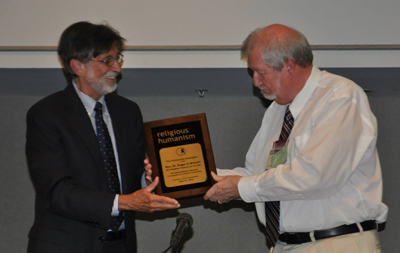
At the 2013 UUA General Assembly in Louisville, KY last June, the HUUmanists held our annual business meeting. At that meeting we had the pleasure of awarding the first ever Religious Humanist of the Year Award to our distinguished board member, the Rev. Roger A. Brewin. In his introduction to the award presentation, president John Hooper listed these accomplishments that made Roger the obvious choice for this honor:

  • Roger has spent 37 years as an ordained minister - at 9 congregations and one campus ministry.
  • Roger received his BA from St. John Fischer college, his  MDiv from United Theological Seminary in Dayton, OH, and his  DMin from Chicago Theological.
  • Roger has been our Journal editor for 15 years.
  • He has been our GA Booth Coordinator , "the booth boss", for countless years.
  • As the HUUmanists Social Justice Director:
    • Roger was the Librotraficante project originator, SmUUgling in 400 banned Spanish heritage books to Phoenix, AZ and helping set up an underground library, 100 books (and another library) in Louisville, 200 more to Tuscon and El Paso.
    • Roger created Ribbons not walls, a project to give artists direct means to be involved in immigration justice.
  • He is a peripatetic Ambassador for UU Humanism - visiting 20 churches and conferences this year alone.
  • He was a member of executive board of UU Ministers Association, including five years on guidelines committee.
  • Roger has always been an active leader in controversial Unitarian Universalist Association issues.

"In summary," John concluded, "we give this award to Roger Brewin for his extraordinary service to Humanism and Unitarian Universalism."

Roger's remarks:

Thank you John, for the kind introduction; thank you to the Board of HUUmanists for the recognition; thanks to all of you who have come or stayed around to see this presentation.

I believe I received this award because I am an old fashioned kind of humanist - to be precise, an old fashioned Midwestern kind of humanist, in the mold of those proto-humanists who populated the Free Religious Association, the Western Conference of Unitarians and the Iowa Sisterhood.  I feel, as many of those pioneers did, that humanism is less about what you believe (or don't believe) and more about what you DO.

To put things in the correct priority - humanism, particularly Religious Humanism, is mostly about what you find you must DO, in response to what you happen to believe.

I'm a humanist in part because I was raised that way - and that upbringing lead me in my forty years of ministry, to call repeatedly, for the application of science, logic and common sense in every aspect of life.  But I'm also a religious humanist because those calls must always be balanced and enhanced by compassion.

I'm a religious humanist because throughout my education and career, I pursued a strong interest in the religious and ethical views of my fellow human beings, in particular what actions they took as a result of what they believed.  It's not what we think or believe that makes us moral, it's what we DO.

I'm a humanist in part because I've been over the years, a social activist - for peace, for free speech, for reproductive rights and most recently for immigration reform.  I feel that humanists should not simply hold convictions about such matters, they should act to better the human condition.  It's what we DO that changes things, not what we believe.

I'm a religious humanist because religion, especially liberal religion, and most especially Unitarian Universalism says to us - if you believe strongly in something - you must help to bring it to fruition.  There are no other moral agents, besides us.

Finally I'm a religious humanist because one of the ethical demands of religion is the obligation to get others, as well as ourselves, to commit to something bigger than ourselves,  

To me as a humanist, that something bigger is nothing supernatural - to me personally, that something bigger can be summed up in four words:  family, friendship, community and cause.   The particular constellation of values that qualify as your "something bigger" may well be different than mine, and that is OK, but mine are:  family, friendship, community and cause.

Family:  Katherine, my wife of forty four years, and my friend since the seventh grade, is here tonight, having driven 320 miles today, to see me give this brief speech,  Since she is still a couple of weeks from retirement, , she will have to drive back to Chicago tomorrow, 320 miles the other way, in order to be at work on Monday morning.  We have done this sort of thing for one another, and one another's families, for a long time.  Of such commitment to doing well for one another, is family built.

Friendship:  My friend Jack Reich, has been at eleven straight General Assembly booths with me for the humanists.  We have pursued, over many more years, quite a few adventures  -  not just as reflections of our being humanist, but in the deliberate DOING of what humanism demands. Many of those adventures have been initiated by Jack's favorite phrase "Say, I have an idea ..."  Together we have done the hard work of moving past disagreement, and turned a number of them into action - deepening our friendship as we did so,  

Community:  to receive this award at General Assembly is particularly gratifying, since I have seen this week, and received congratulations from, so many colleagues and members of congregations I have served.  This is the epitome of community for me - a gathering of the newly excited, the constantly re-inspired, and the deeply committed.

Cause:  To receive recognition from the UU humanists is a delight.  This is a group that has moved steadily from solid intellectual underpinnings, towards a growing commitment that takes on the great social needs of our society, indeed of the human race.  HUUmanists are, more than ever, a source of compassionate living, service to others, and dedication to the cause that call us, not just to do SOMETHING, but to do WHAT IT TAKES, so that, in the words of the UU  hymnal, "Earth shall be fair, it's people glad and wise." 

Thank You.  

Categories: 

Thank You To Our Fabulous GA Booth Volunteers!

Thank You, Mary, Jack and Dick!!!

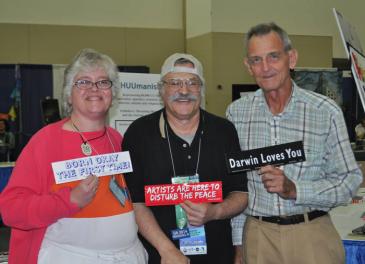
The HUUmanists booth at the 2013 UUA General Assembly in Louisville, Kentucky was a big and busy place to be. Besides showcasing the Ribbons Not Walls art project and the Banned Book collection project, the booth was a place to buy Humanist books, bumper stickers, pins and magnets. Many people stopped by to chat about Humanism in the UUA and to join or renew their membership.

The booth was organized and run by the energetic Roger Brewin and assisted at various times by board members John Hooper, Pat Mohr, Maria Greene and Lowell Steinbrenner. We couldn't have kept up with the constant traffic if it wasn't for three dedicated HUUmanist members who were there to help:

  • Mary Bellamy is from Vienna, VA and is a local group leader for the Humanist group at the Unitarian Universalist Congregation of Fairfax. 
  • Jack Reich is from DeKalb, IL and has been helping his friend Roger table at GA, district assemblies and other places for "many, many years".
  • Dick Renfro drove over from Lexington, KY where he is involved with the Humanist Forum of Central Kentucky and the UU Church of Lexington.


Categories: 
Tags: 

The UU Humanist Association Supports Humanist Chaplains in the Military

Jason Heap is eminently qualified to be a military chaplain and he has the endorsement of a religious organization, the Humanist Society. In a recent Washington Post "On Faith" article titled Humanists want a military chaplain to call their own, Kimberly Winston quotes Heap,

“This is my chance to give back to my country,” said Heap, 38. “I want to use my skills on behalf of our people in the service. Hopefully, the Navy will see where I can be useful.”

Unfortunately, the Humanist Society isn't one of the approximately 200 organizations that the Department of Defense recognizes as having the right to endorse chaplain candidates. This needs to change. With non-theists representing a significant percentage of the military, as they do in the general population, Humanists and other non-religious service members deserve the confidential comfort and support that chaplains provide. With many troops shying away from psychological counseling because of fears of repercussions to their military career, chaplains serve as trained listeners who can help troops deal with stress and anxiety.

The UU Humanists Association fully supports the Military Association of Atheists and Freethinkers (MAAF) in their effort to change the status quo in the military chaplaincy.

Meanwhile, the religious right is countering the call for more diversity with predictable claims of persecution. “They’ve pushed for Christian privilege under the guise of religious freedom,” says Jason Torpy, MAAF president. This is no different than the Catholic church's opposition to women's reproductive health rights under the same "logic". We were pleased to see that the Rev. Sarah Lammert, the UUA's Director of Ministries and Faith Development, quoted as saying,

“I think the rights of Christian chaplains are already protected. And in fact, the numbers of Christian chaplains in the military far outreach the demand for those particular faith groups. It’s disproportionate,” said Ms. Lammert. “No one faith should be given a spotlight over the others.”

Unitarian Universalism has a proud Humanist legacy and constituency and we encourage you to support MAAF and the effort to provide Humanist chaplains for our brothers and sisters in the military.

Categories: 

Pages

Subscribe to Front page feed