A Local Group Profile: Humanists of UUCF

[Editor's Note: This is the first in a series of Local Group profiles that we are doing in order to give members an idea of the variety of types of groups out there and to help share ideas. If you are associated with a local group, please share your profile!)


Humanists of UUCF is based at the Unitarian Universalist Congregation of Fairfax, Virginia.

When was the group founded?  We had our first regular meeting in September 2012.

When and how often do you meet?  We meet monthly on Monday evenings for 90 minutes.

What is your average attendance?  It varies greatly from about 15 to 40 attendees.

How do you fit within your congregation’s organizational structure?  Our group is a chartered small group in the Adult Programs section of our congregation’s Education ministry.  There is also a separate Humanist covenant-like group that grew out of the same initial discussions among members but is not officially linked to our group.

What kinds of programs have you had?

  • book talks (Rev. Bill Murry, Becoming More Fully Human, and David Niose, Nonbeliever Nation)
  • talks about the secular movement (Jason Torpy, Military Association of Atheists and Freethinkers, David Tamayo, Hispanic American Freethinkers, and Frank Bellamy, Secular Student Alliance)
  • group discussions (What would a Humanist service look like? What does a Humanist do for the holidays?)

Do you have a relationship with any other UU Humanist Groups?  Dr. Cliff Andrews of the UU Humanists (Annapolis, MD) has been a speaker for one of our meetings.  We exchange meeting information with the AHA (Atheist/Humanist/Agnostic) Group of the UU Congregation of Frederick, MD.  We hope someday to have a picnic or some other joint event with both groups.

Are you associated with any non-UU humanist or secular groups?  We are a member of the Washington DC Area Coalition of Reason and an affiliate of the American Humanist Association. We have a meetup group and our meetings are also often posted on meetup by the Northern Virginia Chapter of the Washington Area Secular Humanists and the DC Region Atheists Meetup Group.  We estimate that between 10 and 30 percent of attendees at our meetings are from one or the other of those groups depending on the topic.

Do you use social media? If so, which media?  We have a meetup page

Are your meetings advertised outside the congregation?  In addition to the advertising of our events on meetup , we post information about some of our meetings on local Patch sites (internet news site).

Categories: 

Big, Bad Booth?

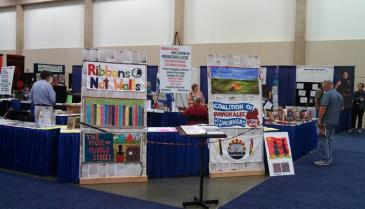
I've been "running" the HUU booth at General Assembly, with an able assist from Jack Reich and each year, a rotating cast of enthusiastic others, since 2002.  I take some pride in the fact that we are usually among the largest and most energetic displays in the exhibit hall.  I take pride in the fact that we share our space with other humanist and social justice organizations - this year the Channing-Murray Campus Ministry, the Humanist Institute, Secular Student Alliance, and a Gun Control group called "Change the Conversation," were all on board.
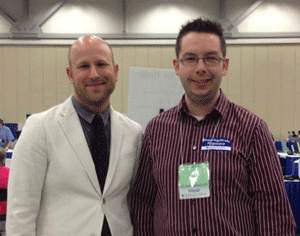
Greg Epstein of Harvard Humanists and Kevin Watson of The Humanist Institute

To me, our prominence among exhibitors reflects some of the best of UU humanism:  the fact that we believe enough in our values and programs to promote them with vigor; the fact that we are reminding our fellow religionists, gently, that UUism runs on humanist values, from the language of the Purposes and Principles, to the emphasis on individual conscience in religious matters, that is at the heart of many UU congregations, to our Association wide penchant for social justice action.  The  connections with other groups also speaks to me: the Humanist Institute is not only a major part of training the next generation of humanist leaders, it is also an incubator for educational materials for all those call humanism home; both the Secular Students and UU campus ministries are at the forefront of creating humanist communities for a new generation.
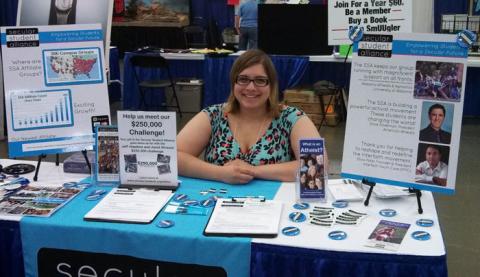

Jessica Kirsner of Secular Student Alliance
Two years ago the HUUmanists board began cautiously endorsing social justice projects, in response to the call for a Justice GA.  The focus on censorship in the Arizona Banned Books project appealed to a broad humanist consensus - even though it was clear that our national membership held divergent views on the policies in question.  The focus on literature and the right to read, and the creating of alternative libraries based on the infamous eighty Tucson volumes, in Phoenix, in El Paso and in Louisville, created a common front. The invitation issued to fabric artists, to add their vision with the "Ribbon" project, an effort in which emotion lead reason to some extent, was also adopted only after considerable reflection.  We didn't want to simply slap the organization's approval on something, and then regret it later.  

So when Janet Fisk (backed by a UU social justice staffer) asked this past spring if our June 2012 booth could host her "Changing the Conversation" program on Gun Control, I didn't know if we would have enough time for the kind of careful deliberation we had previously given such decisions.  I needn't have worried: Janet's reasoned approach of aiming to involve gun rights as well as gun control advocates in the same broad ranging conversation, and her use of the arts (she is a documentary film maker) an area of social action with which we had become familiar, was a combination that carried the day.  Sensing the social urgncy of the issue, and the need for a variety of activist approaches under our HUU rubric of "reason and compassion," our board said: "if there is any other issue we should be adding to our agenda this year, this is it."


Janet Fisk, filmmaker

Janet's films and fliers joined a booth already adorned with the two dozen "Ribbons Not Walls" art pieces, and 160 copies (two full sets) of the Banned Books, headed to the library of the Americana Center, which serves 17 immigrant groups in Louisville.  

Arguably, the biggest, baddest thing at the booth this year was the sizable contingent of HUU Board members and regional volunteers who helped staff it.  They engaged folks who came by (I estimate about 2,500 of the 3,500 or so GA attendees visited our location) answered questions, handed out literature, sold books, stickers, pins, memberships and sponsorships for our social justice programs. Others have done the same in years  past, but in much smaller numbers.  Combined with our increasingly productive board meetings, livelier web presence and growing publication and social justice profile, this years HUU booth effort gives me great hope.

Come see us in Providence - June 2014.

Roger Brewin, booth coordinator

Categories: 

Ribbons on the Road

A collection of two dozen fabric arts panels made by humanist and UU artists around the country, began its fall tour during the last weekend of September, with a showing at a Michigan community event and a UU Fellowship Sunday service.  "Ribbons Not Walls" (a project of HUUmanists) invites people to create yard long representations of immigration related events and themes.  The collection includes a starkly poetic rendering of a portion of the "wall" between the US and Mexico by 13 year old Illinois UU Alayna Vesto, two panels featuring the primitive quilting style of Linda Lee, lead artist of the well known Farmworkers Memorial quilt out of Florida, and the HUUmanists "Librotraficante" (Book SmUUggler) Iogo, stitched and be-ribboned by Michigan secular humanist Sherron Collins.  

"Ribbons" began as an outgrowth of the Banned Books project run by HUUmanists for the 2012 UU General Assembly in Phoenix (the "Justice GA."). Initially artists depicted themes from some of the 80 books, mostly by Hispanic authors, that were removed from Tucson classrooms when Arizona lawmakers voted to end "Ethnic Studies" in that state's schools. (See RibbonsNotWalls.org or the facebook page ribbonsnotwalls for more information on the Banned Books project.)   Gradually the art project widened to include impressions from congregational events about immigrant rights and culture, and then to individual and group reflections on the impact of the issue on our society. 

As panels came in through the spring of 2012, they were put on display singly and in small groups at more than a dozen humanist meetings, UU congregation and district conferences. The first full installation of all the panels was at the HUUmanists booth (see "Big, Bad Booth" article elsewhere in this issue) at the June 2012 GA in Louisville, where it was seen by over two thousand attendees.  Subsequently the minister and members of Berrien UU Fellowship in St. Joseph, MI arranged for the full collection to be on display September 28 at the Berrien County Unity Fest, an annual political event held this year in a huge 19th century barn.  The Ribbon panels were stretched from the rafters, above the heads of 150 diners and dancers. The next morning at BUUF's Sunday morning service, led by Roger Brewin, self-styled "curator" of the project, the panels were held aoft by congregants, then formed a visual backdrop for the post service discussion.

The next stop for the Ribbons tour will be Northern Hills UU Fellowship just outside Cincinnati, with a service by Brewin on the morning of October 27, followed by a public showing throughout the afternoon.  UU ministers in the Ohio River (study) Group will get a look at the panels (and a chance to contribute to the collection) on Wednesday evening November 13 in Dayton, Ohio.  Further showings at art galleries and on seminary campuses are being negotiated.  Humanist groups and UU congregations that would like like to host the art work in 2014 are invited to contact Brewin at Rabrewin@aol.com,  773 881 4028 or 773 551 8540.

"Ribbons began as a way to let artists shine a different spotlight on the issue of censorship, and the right of every culture to define itself without interference," says Brewin - "these are aspects of the broader immigration question that appeal particularly to humanists.  The Ribbons art does not demand that you take a particular political stance on immigration, or that you follow a particular set of actions.  It does demand that you encounter the people and communities involved, through the honest filter of your own emotional reactions and rational convictions. The art both brings you closer to people, and gives you a medium through which to put aside reactivity, and encounter their humanity.  As a humanist, I have "faith" that that sort of encounter can change things." 

Categories: 

Pages

Subscribe to Front page feed