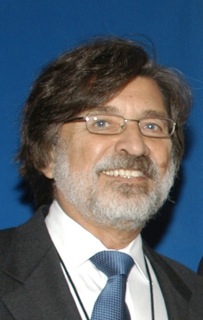
Secular Leadership Summit 2014

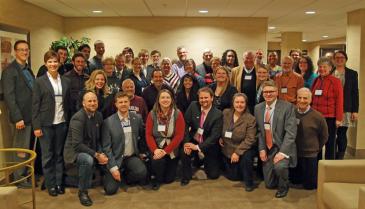
UUHA president John Hooper recently participated in the Secular Leadership Summit, on January 25, 2014. The event was held in Columbus, OH and was sponsored by the Secular Student Alliance. This meeting, formerly known as the Heads Meeting, brings together the leaders from all of the major non-theistic organizations to discuss strategy and to coordinate activities.

John described the event as, "a very positive meeting" and the people as, "a really cool bunch of folks". 

Categories: 

The Humanist Community Project & UU Humanists

Have you heard about the Humanist Community Project? They are, "a Cambridge-based initiative to help create, establish, and connect a stronger nationwide network of Humanist communities focused on individual, group, and societal betterment, for the benefit of the secular and freethought movement." In other words, they are group that seeks to promote "Godless Congregations". Greg Epstein, the group's leader, described the project at the HUUmanists 2013 UUA General Assembly program, and explained that "Godless Congregations" is also the title of an upcoming book that he and co-author James Croft are working on. 

It has been the Humanist Community Project's intention to "work with and learn from emerging and established forms of positive community for the nonreligious", including the UUA, from the begining. The UU Humanist Association, fulfilling it's mission "to provide an active interface between Unitarian Universalists and the secular community", has been seeking to assist the group with funding and with facilitating dialog and connections between the HCP and UUA. 

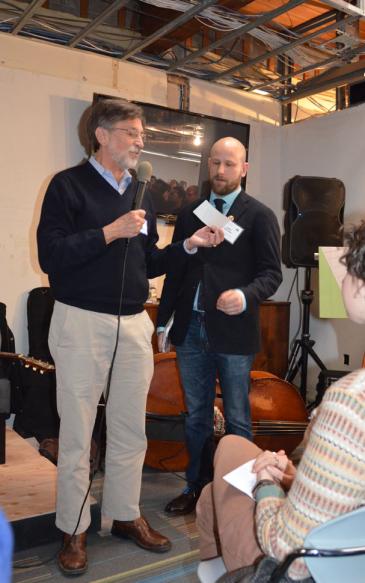
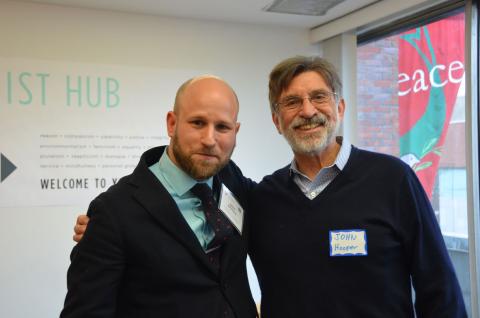
President John Hooper and director Maria Greene represented the UU Humanists at The Humanist Hub grand opening celebration in Harvard Square, Cambridge, MA on December 8, 2013. At the event, John was pleased to present Greg with the first of several checks from the UU Humanists. He had this to say:

I’m very excited about the potential for cooperation between Unitarian Universalists and the Humanist Community Project.  Developing a close working relationship with Greg Epstein’s initiative is a natural for the UU Humanist Association.  The UUHA Board voted unanimously to invest $5000 in this synergistic, cooperative effort.  But ours isn’t the only UU investment in HCP.  The UU Funding panel has also awarded a $5000 grant to the program (initiated by the UUHA), the UUA is putting in $3000, and individual UUs connected with the UUHA have contributed another $12000.  We are looking forward to catalyzing cooperation between the HCP, the UUA and many UU congregations across the country.  As Maria Greene, our development and communications director, has described in a recent AHA Humanist Network News article, Unitarian Universalist Congregations are natural “Habitats for Humanism.”  

Categories: 

On Becoming Humanist - My Personal Journey from Catholic Educated to Humanist, by Bob Koches

Editor's note: this is another essay in the "Why I Am a UU Humanist" series. What is your story? Contact us and let us share it.

My name is Bob Koches, I am a humanist and this is my journey.  I think of humanism as a kinder, gentler form of atheism. 

Humanist Manifesto III , a successor to the Humanist Manifesto of 1933, defines humanism as a progressive philosophy of life that, without supernaturalism, affirms our ability and responsibility to lead ethical lives of personal fulfillment that aspire to the greater good of humanity.   “The lifestance of  humanism - guided by reason, inspired by compassion, and informed by experience encourages us to live life willfully and fully.  It evolved through the ages and continues to develop through the efforts of thoughtful people who recognize that values and ideals, however carefully wrought, are subject to change as our knowledge and understanding advances.” 

When asking the question of my Lake Chapala Unitarian Universalist Fellowship here in Ajijic, Mexico, 90% said they considered themselves atheist, agnostic or humanist.

My journey is really based on the fourth UU principle, which is a free and  responsible search for truth and meaning.

As you may know, I was educated and raised Catholic, and went to Catholic school from first grade through university.  Kathy, my wife, asked me one time, out of curiosity, why I was no longer a Catholic.  I answered, “Because I went to Notre Dame, and they taught me to think.”

We all ask the basic questions, “Why am I here?  Where did I come from? How did it all start?”  Or in the words of Doug Adams in “The Hitchhiker's Guide to the Galaxy” the question is “What is the meaning of the universe and everything?”  Of course the answer, as you may know, is “42” but that doesn’t really suffice here.

When I was in high school at Pius X, I took a class in my senior year called “in apologia” or “in defense of the faith” taught by a young priest called Father Parnassus.  He stated that Catholicism  could be and should be defended by logic.   Of course that only works if you accept the basic assumption that there is a god.  If you don’t, it all “goes to hell in a hand-basket.”

The next year it was off to Notre Dame, where I learned about the Greek philosophers.  Socrates taught me to doubt and question everything.   Of course Socrates, in his time, questioned the validity and existence of all those Greek gods.  He developed what is now called “the Socratic method,” which is basically asking questions, questions, questions, to get at some semblance of the truth.  He was a humble man, and felt he hardly knew anything.  From the Greeks we also get the aphorism, “Know thyself.”

Plato, through his allegory of “The Cave,” warped my sense of reality, saying that what we perceive is not real, but merely shadows on a cave wall.  Another parable of this is the blind men and the elephant.  Not Plato, but still the same result.  We only get glimpses and pieces of what reality may be.

Aristotle invented formal logic and is considered the father of what we would now call “The Scientific Method.”  One of his other claims to fame is the concept of “first cause” or “the unmoved mover.”  This is another term for god, which states that god had no beginning.  Thomas Aquinas used this as one of his proofs of the existence of god.

One of the best definitions of god I ever heard was from Paul Tillich, a German theologian, whom the Christian right considers at best, a panthiest and at worst, an atheist.  He said, and I paraphrase, “That which you cannot explain:  the wonder, the magic and the mystery in the world, people call ‘god’,  until some of these wonders, magic and mysteries can be explained through science.”   In other words, the mystery and wonder in the universe is just something we have not explained yet.

In looking at the history of man, it became clear to me that god was created in man’s image, not vice versa.  The study of history showed me that early civilizations were religiously based.  These theocracies were then governed and controlled by the priests.   If you look at what is happening in America today, you can see the same pressures being applied.

It is interesting to me to note that there are many atheistic religions in both the ancient and modern world, including forms of Buddhism, Hinduism, Judaism, Jainism and Confucianism.  It is also interesting to me to note that almost all of the religions of the world have, in some way, the ethic of the golden rule.

Therefore, I concluded that “humanism” or acting in a humane way towards other people, does not need to be tied to religion.

So let’s talk about some objections to atheism.  Kathy’s dad used to say, “If you’re right, and I’m wrong, I have lost nothing; but, if I’m right, and you’re wrong, you are in big trouble.”  This is known in philosophical circles as “Pascal’s Wager.” 

There are really two problems with this:  first of all, which religion?  There are many.  It seems to me a little egotistical to limit it to just one.  The second problem is really, “it is playing the odds” and I would rather the odds of living a good and happy life now as opposed to in heaven.

Besides, the new Pope, Francis, has said that if an atheist leads a good life he can go to heaven.  So, all bets are covered! 

I also have a real problem with a literal interpretation of the bible by creationists that says man, dinosaurs and dragons co-existed together.  The concept is so ridiculous I am not going to bother to talk about it.

I am, in some ways, envious of true believers, people of faith, who are so certain, through whatever life experiences they have had, that they are right.  Unfortunately, I have never had, like Paul on the road to Damascus, that bolt of lightening come down and show me the ultimate truth.  With a person who has this type of faith, there is no arguing.  They cannot accept my facts, and I cannot accept their blind faith.  So we are at an impasse.  If they live a life consistent with their faith, rather than a life of hypocrisy, then I can accept them.

So, where does that leave me on this journey?  There are many nooks and crannies of thought that I haven’t covered, but when it comes to living a humane life, a life consistent with caring for our fellow man, I still prefer to see the wonder and awe of the universe as it is explored by science.   

For the atheist and humanist there is wonder and mystery about this process of existence, but not the kind which leads to fear or rejection. Rather, the atheist’s and humanist’s wonder and mystery is enthusiastic curiosity about all those unknowns, which are just waiting to be revealed. 

As the great Albert Einstein said:  “The important thing is not to stop questioning.  Curiosity has its own reason for existing. One cannot help but be in awe when one contemplates the mysteries of eternity, of life, of the marvelous structure of reality.  It is enough if one tries merely to comprehend a little of this mystery every day.  Never lose a holy curiosity.”      Namaste.

President's Corner

Before I tell you about the important progress we are making in both reinforcing the Humanist core of Unitarian Universalism and acting as a bridge between Unitarian Universalism and the secular/non-theist community, I have an exciting announcement to make:

On November 18, 2013, your Board of Directors unanimously approved the appointment of Maria Greene to the part-time position of Development and Communications Director of the Unitarian Universalist Humanist Association (HUUmanists).  Maria will guide our efforts in three areas: Membership Development/Fundraising; Local Group identification, formation and affiliation; and Communications. Please join me in thanking Maria for taking on this critical job in our movement and in giving her our enthusiastic support.  In a related action, the Board has appointed Rev. Dr. Neil Gerdes to the position of Secretary of the Association, replacing Maria.

Let me tell you about just a few of the exciting "happenings" involving your UU Humanist Association.

We have balanced the budget! Thanks to increasing paid memberships and donations, we are taking in more funds than we are expending. Continually increasing our financial resources will allow us to accomplish more of the ambitious objectives we have set for our Association.  To make membership more widely attractive, we are experimenting with changing our dues structure. Starting on January 1, 2014, yearly dues will be $35, which will include the electronic version of the Religious Humanism Journal.  Dues will remain at $60 for those wanting a print copy of the journal. But we need you help. You can make a donation and encourage others to join us.

Neil Gerdes and I accompanied the archivist of Meadville Lombard Theological School on a visit to the American Humanist Association offices in Washington, DC.  Roy Speckhardt, the Executive Director of AHA, gave us an extensive tour of their facilities and their stored document areas.  A plan was developed for several boxes of materials to be sent to MLTS for possible inclusion in the Humanist Archives. More documents will follow, both from the AHA and from many other sites across the country.

HUUmanists Board member Lowell Steinbrenner and I have joined the advisory board of Greg Epstein's Humanist Community Project (HCP) and are working closely with Unitarian Universalist Association staff and others to maximize UU Humanist participation in the project.  Your Association has committed $5,000 to HCP and is actively seeking more funding through UU resources. This is a huge opportunity for us to carry our message to freethinking folks - especially young people - in communities across the country who are not inclined to typical church attendance.

Preliminary planning for the 2014 UUA General Assembly has begun. We are envisioning a huge Humanist presence at GA centered around program events (both inside and outside of the GA itself) and a large booth dedicated to UU Humanist outreach, local groups, and social justice.  I'll give you all the details as soon as we learn if our main program proposal is approved by the GA Planning Committee.  But mark your calendars for June 25-29, 2014.  The 2014 General Assembly will be held in Providence, RI.

This could be a break out year for the Unitarian Universalist Humanists.  We have gotten people's attention. This is our time.  Our congregations need to hear our message and we need to be there for the searchers in our communities who are looking for the kind of life stance that we have embraced - that of reason, compassion, and community. We need you now more than ever to join in the cause.  

Categories: 

UUA President Morales on Science and the Search for Meaning

Unitarian Universalist Humanists will be very encouraged by reading UUA President Peter Morales' recent article "Science and the Search for Meaning," published in last summer's issue of The New Atlantis.  Peter forcefully reaffirms the Unitarian Universalist principle: "we affirm and promote a free and responsible search for truth and meaning." The entire essay could be interpreted as a thoughtful explication of our Unitarian Universalist Humanist Association (HUUmanists) core values of Reason, Compassion, and Community. Thanks, Peter.  We needed that!

Here are Peter Morales' words:


We affirm and promote a free and responsible search for truth and meaning.” This simple proposition, which could serve as the motto of any scientific society, secular organization, or humanist group, is in fact one of the seven principles that guide the Unitarian Universalist religion.

Unitarian Universalism was formed in 1961 through the merger of two different religions, Unitarianism and Universalism — the first a Christian heresy, the second at least unorthodox, if not also heretical. Unitarianism rejects Trinitarian theology, and Universalism asserts the salvation of all. Historically, Unitarians and Universalists stood up for what they believed, even at the expense of their personal safety. Likewise, Unitarian Universalists are committed to truth and meaning to this day.

Read the full article at The New Atlantis website...

Pages

Subscribe to Front page feed