Coming Out as a Humanist

I am a humanist. That’s not something I always share with others, especially here in South Carolina, where the first question people generally ask upon meeting you is, “So where do you go to church?”; where people regularly talk about God as their co-pilot and Jesus as their fishing buddy; where prayer is considered a viable solution to every problem, from ending drought to finding a parking place. Publicly admitting that you are a humanist – or an atheist, agnostic, skeptic, free thinker, or any other variety of nonbeliever – anywhere in America is about as risky as burning a flag in an American Legion hall. Where I live, being a nonbeliever can get you denied a promotion and fired from your job. It can get you disowned by your family and deserted by your friends. It can get your house or car vandalized, and it can get you physically harmed. Prejudice against nonbelievers may be the last socially acceptable bigotry. 

So it may seem strange that I strongly advocate that we humanists come out of the closet, but that’s exactly what I think we should do. As we well know, the phrase “coming out of the closet” was first used by LGBT people, and I think it is relevant for us humanists, as well, because being a nonbeliever, like being gay, carries a stigma. Even the symbol for atheism is a scarlet A. People assume that if you are a nonbeliever, you have no morals, meaning, or joy in your life, and the only way to dispel that myth is to show people that they are wrong. We have learned from our LGBT brothers and sisters that the way to melt the fear, ignorance, and hatred in our society is to come out and show others that LGBT people are people, too. Society also needs to see that humanists don’t have horns and tails. When I was growing up, we were not even talking about homosexuality; now LGBT people are getting married, even in South Carolina, and all of us regard Ellen Degeneres as our best friend. The remarkable pace of change in attitudes toward LGBT persons in our lifetime would not have happened unless, one by one, they started coming out of the closet to their sisters and brothers, mothers and fathers, friends and neighbors, bosses and coworkers. We humanists need to do the same.

This is how a nation’s consciousness is changed – one person at a time.   We are already seeing America’s consciousness changing in regard to humanism. The fastest growing religious group in America is, ironically, not religious. They are the “Nones,” the religiously non-affiliated, and they comprise about 16% of Americans today. Among 18 to 35-year-olds, that number rises to one in three. This is the highest level of religious disaffiliation since the Pew Research Center has been taking such polls. 

Coming out as a humanist can be transformative socially, and it can be transformative personally. One of the most painful coming out stories I have heard was told to me by a member of my UU congregation. When her mother, with whom my parishioner and her two small children were living, discovered that she was an atheist, she kicked her daughter and her grandchildren out of the house. Not content to stop there, the mother informed her daughter’s employer, who promptly fired her. Says my parishioner, “It was a very painful and stressful time in my life that I wouldn't wish on anyone, but I wouldn't go back to that life if you paid me. The fear and guilt that I was constantly wracked with was almost overwhelming. The peace I found on the other side of atheism is amazing.”

Her story tells me two things. First, as we have learned from our LGBT brothers and sisters, we have to be selective about coming out. If coming out as a humanist would mean risking your job, your home, your support system, your children, or your safety, you would want to think twice about it. Everyone has different circumstances and different personalities, so we have to come out on our own time-table and in our own way. But I suspect we can come out with more people more often than we assume. In preparation for writing her book Coming Out Atheist: How to Do It, How to Help Each Other, and Why, Greta Christina read and listened to literally hundreds of “coming out atheist” stories, and there was immense variety among them. But the overwhelming majority of cases turned out well. She heard from exactly one person -- just one person -- who said they regretted having done it. Even as horrific as my parishioner’s coming out experience was, after all was said and done, she was glad she did it.

The second thing my church member’s experience tells me is that peace comes from being true to yourself. The peace she found is the peace of living with integrity. It’s the peace of making your words and actions consistent with your values. It’s making your outside match your inside. I know, not from reading books or hearing from others, but from my own personal experience that living with authenticity is the most powerful part of coming out of the closet, whatever your closet may be. And I did not have that experience in my life until I met a group of people called Unitarian Universalists.

The poet William Ward writes:

         To laugh is to risk appearing the fool,
         To weep is to risk appearing sentimental,
         To reach out for another is to risk exposing our true self,
         To place our ideas, our dreams before the crowd is to risk their loss.
         To love is to risk not being loved in return,
         To hope is to risk despair,   

         To live is to risk dying.

         But risks must be taken, because the greatest hazard in life is to risk nothing.
         The person who risks nothing, does nothing, has nothing, is nothing.
         He may avoid suffering and sorrow, but he simply cannot learn, feel, change, grow, love....live.


Coming out as a humanist is really about the courage and peace of taking the risk to be yourself, and that’s really the only life worth living.

Rev. Dr. Neal Jones

Unitarian Universalist Congregation of Columbia, SC


Photo credit: Samuraijohnny on Flickr
Categories: 

The Story Telling Animal

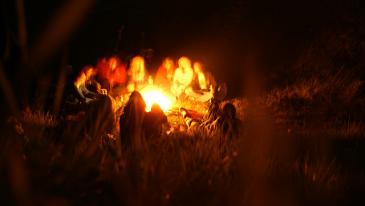
Walt Whitman sang The Body Electric. Let us sing The Mind Electric for its soaring imagination. Nothing distinguishes our species more than our creative capacity and need for story telling. Stories can be grounded in fact and history or wildly fantastical. Both avenues define our culture, our selves, and our species. They are tools for passing down learning and expressing our hopes, desires, needs and are the major source of entertainment. For millennia, they were told person to person, or person to persons, especially around campfires and hearths in the evening. The invention of writing not only aided their spread but also their saving. In the modern world, story telling is the staple of radio, movies, television, and the internet.

Its important to keep stories of fantasy, conjecture, and real events separated from fabrications which are purported to be true. Propaganda and confidence games are especially egregious because the perpetrators know that what they say is false with the intention to misinform and mislead. Fox News being an obvious example. And isn't it revealing that each of the Western faiths that originated in the Middle East rejects the stories and dogma of all other religions including their dozens of divisions and thousands of splinter sects? 

The stories told by the Abrahamic religions are, on the whole, presented as literally and historically true, but there is little objective truth in their Holy Books, according to experts like Carol Meyers. The Old Testament is, at best, a sketchy history of early Jewish tribes, more a retailing of tribal myths. And while some of the mythical stores are inventive, as moral lessons, they can be appalling. Is there anything in the Quran that is as blatantly xenophobic as the Book of Exodus? The stories told in the Book of Exodus, for example, and the characters are total fabrications. Nothing in Exodus is true. None of it happened. Further, the God depicted in Exodus is a jerk at best; at worst, mad. Why did he bring the plagues on the Egyptians while “hardening Pharaoh's heart” after each plague “so Pharaoh would not let the Israelites go”?

[Carol Meyers in her commentary on Exodus suggests that it is arguably the most important book in the Bible, as it presents the defining features of Israel's identity. . . . Meyers is a feminist biblical scholar. She is the Mary Grace Wilson Professor of Religion at Duke University. Meyers studied at Wellesley College and Brandeis University. -Wikipedia]

Do the departments of religion at the best universities degrade those institutions when publishing sham tracts pretending scholarship? Is religious scholarship a contradiction? Society suffers when untruth is given an academic imprimatur. What is mostly going on at these universities is careerism. Young people from religious cultures who go into religion as a career often do feel the “Call”. But those who learn better as they continue now have career investment. Reference The Clergy Project which is a support network for mostly older religious professionals who no longer hold supernatural beliefs. 

So, lets keep telling our stores while remembering that the proper place for fiction whether Swan Lake, The Sixth Sense, or Star Wars is in the arts, not in science, politics, nor religion.  

Tell me a story.


Image credit: Charlie Dees, Flickr 

Categories: 

Ribbons Not Walls Reaches Fifty!

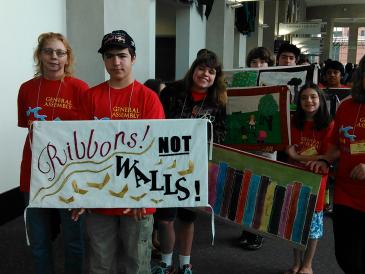
They’ve been hung from the rafters of a 19th Century barn hosting a progressive dinner dance in rural Michigan, paraded by youth for the plenary delegates at General Assembly in Providence, held by parishioners as a “living ribbon” at the close of several UU Sunday services around the country, and have welcomed customers from the walls of a neighborhood Starbucks as part of a local art walk on the south side of Chicago.   As this is written, the twenty six fabric art panels that comprise Ribbons Not Walls, a UU Humanist sponsored project on immigrant rights and culture, grace the walls at the UU Congregation of Las Vegas, for a month long program titled “Borders and Boundaries.”  It is the 50th venue for “Ribbons” since the spring of 2012, and will raise the number of viewers who have directly interacted with the art to over 8,000.

“Ribbons” began as a half dozen yard-wide panels, mostly reflecting themes and cover art from books by Hispanic authors, (see separate article on the “Banned Books” project) taken from Tucson classrooms when the State of Arizona banned “Ethnic Studies” courses.  Then the youth of the Navigator (coed, inclusive) Scouting group from Countryside UU Church in Palatine, IL contributed four batik style panels, reflecting aspects of the immigrant experience.  More contributions from a total of forty artists, working individually and in groups, were added, including depictions of humanist and UU immigration justice projects.

Of particular note are panels by the youngest and the oldest contributors – “The Wall” a rich dark acrylic on muslin rendering by 14 year old Alayana Vesto, and “Banned Books,” human figures bannered with book titles against a traditional quilt pattern, by 94 year old Gloria Weberg.  

Two panels by Linda Lee, lead artist for the Lake Apopka Farmworkers Memorial Quilt titled “Scenes from the Muck – labor and leisure” done in traditional primitive piece quilting style, toured as part of our exhibition for a year.  They have now been returned to Linda with our profound thanks - photographs of her pieces remain in the exhibition catalog.  The full farmworker quilt is known for its 128 + depictions of farmworker life, and for appearances throughout southern states at union rallies and social justice gatherings.  

The latest additions to the collection are two Commemorative panels for victims of the Los Gatos plane crash, subject of the Woodie Guthrie song “Deportee.”  For decades, activists have worked to uncover the names of the twenty eight braceros who died following their legal work on the California harvest.  Just last year the last identities were uncovered, and a new engraved headstone bearing all twenty eight names, marks the place where they were buried anonymously.  Much of the work was done by author and performance artist Tim Hernandez.  UU Humanists is proud to partner with Tim and others who worked on the 28 Deportees Memorial, by gathering small fabric panels of handprints (a sign of support) and leaves (from Guthrie’s line “Who are these Friends, all scattered like dry leaves?”) made by UU and Humanists children and adults around the country.   These are being stitched into panels, each one bearing one of the names. 

Ribbons Not Walls is an artistic response to a highly complex political issue.  In the finest humanist tradition, we use the emotional and intellectual impact of the artist’s vision, to ask audiences to engage the culture and the struggles of immigrant communities and individuals.  We do not ask you to take a particular stand (though several of the individual artists clearly do), but simply to be open to letting the works speak to you.  

The growing “Ribbons” collection will go from Nevada to Florida for at least two winter appearances, and then back north in March to be displayed at the Ohio Meadville/St. Lawrence District Meeting in Niagara Falls, NY, and then at the MidAmerica Regional Meeting in Naperville, IL.  You can also see the collection at the UU Humanists booth at the UUA General Assembly in Portland, next June.

If none of these venues are on your itinerary, perhaps you’d like to bring the Ribbons exhibit to your congregation or Humanist group.   Contact curator Roger Brewin at Rabrewin@aol.com or call him at 773 881 4028, or cell 773 551 8540 to make arrangements.

Categories: 

James Croft: "Humanism: Creed of the 21st Century"

The sermon was delivered on Sunday, October 19, 2014, at All Souls Unitarian Church in Tulsa, Oklahoma, by James Croft, Guest Speaker.

What is the point of Humanism?

"To safeguard human dignity while maintaining intellectual integrity. To put people first."
Categories: 

Pages

Subscribe to Front page feed