

UUA, Why Aren't You Nurturing My Spirit?
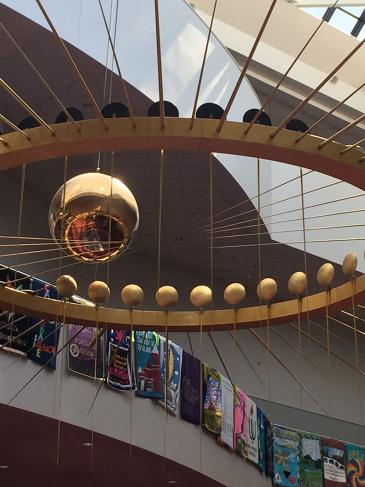
I laughed out loud yesterday when I got to the bottom of the stairs at the Oregon Convention Center for General Assembly and I saw the giant pendulum swinging in the foyer. Pendulums come up often when I'm discussing the place of humanism in the UUA with the people who come by the UU Humanists' booth in the exhibit hall. In the past, I'm told (since I am a new Unitarian Universalist and wasn't there to see for myself) the pendulum swung toward humanism, and now I'm told (and I see for myself) that it is swinging toward theism. The slow, relentless swing of the gold ball in the foyer is mesmerizing and the force must be tremendous, but I say it's time to stop the pendulum's swing entirely.
I just came from the Service of the Living Tradition celebration where the wonderful Marlin Lavanhar gave the sermon. Through the also wonderful power of YouTube, I feel like I know Marlin since I have watched him speak many times in the videos put up by All Souls Tulsa, where he is the senior minister. He also was one of our speakers last year for the UUHA GA program on how to create Sunday services that embrace the diversity of religious thought in our congregations. All Souls Tulsa has weekly services in three different styles to create the right nurturing environment for its humanist UUs, more traditionally religious UUs, and newly integrated Pentecostal UUs, while realizing that people don't fit into boxes and encouraging participation across and between.
The major message of the Service of the Living Tradition sermon was that we need to allow our people to be authentic and express their sincerely held beliefs. Yes, I said to myself as I applauded with the rest. This is only my third General Assembly, and I've gotten this message loud and clear many, many times in GA sessions and services. I've read this message in UU World, and UUA blogs, and on The VUU, the UUA/Church of the Larger Fellowship's on-line talk show. I've heard this message directly from senior UU staffers in Boston when we've met to talk about outreach to nontheists. Yes, we need to allow people to bring their authentic selves to their Unitarian Universalist community. Yes, feeling the need to hide part of your identity is being in the closet, and that is oppression.
Being a nontheist in America, I've used that analogy to LGBTQ experience many times. I've pointed to public opinion surveys that show that atheists are now the most distrusted minority, surpassing gays and lesbians, Muslims, and sometimes even rapists in polls. Fearing and hating atheists is irrational but it is socially acceptable. While I point out that this distrust does not generally result in the level of discrimination and oppression faced by many other minorities, it is still very real. This causes many, if not most atheists to hide their identity and stay in the closet. In some conservative parts of the country this is necessary to keep your job, your apartment, or sometimes even your family relationships. Think about that; sometimes people value their need for others to share their religious faith more than they value their relationship with their spouses or their children. Or put another way, sometimes people are so tribalistic and uncomfortable with difference that it can dissolve love itself, usually the most powerful force in human nature.
But wait! In Marlin's story and the UUA's story, I am the oppressor. I am his oppressor because he did not feel comfortable being open about his authentic self. What is wrong with Unitarian Universalism and what is holding us back from growth is our failure to embrace those who embrace God. Wow! I've heard second hand of ministers saying, "If we just wait for all those old humanist dinosaurs to die off, Unitarian Universalism will be free at last," but I never gave much credence to those stories or I dismissed them as the easily-ignored opinion of a small minority who are outside of the true spirit of UUA inclusivity. I know, with certainty, that Marlin Lavanhar does not feel that way, but yet I've heard both humanists and theists describe the other as "the problem" with the obvious implied solution.
When I discovered Unitarian Universalism after decades of being a "None", I was amazed and happy. It truly was amazing to this former Catholic -- a place where I could take my authentic self and my Humanist family and be loved and supported in ways that I thought were only available to theists or others who could accept the supernatural. I was indignant that I had lived so close to my current congregation for a decade but had been unaware that we would be welcomed there, to the extent that now I work for the UU Humanists trying to get other congregations to be better at communicating that welcome. Unitarian Universalist congregations are the only places in most parts of the country where that is true. But by celebrating that and seeking to broaden and communicate that, I am the problem with Unitarian Universalism!
UUA, where is the nurturing of my spirit? How do you help me deal with those fears that Marlin enumerated so well last night? I don't have belief in a higher power that is going to right the wrongs and wash away the pain using superpowers. I wish I did and I can fully understand why people do because life is hard for everyone, as the sermon pointed out. Grief touches everyone eventually, even the white, middle class, NPR-listening, privileged UUs. So, where are the GA sessions on Grief Beyond Belief? Where are the services that take their inspiration from our creation story, the universe story, and the truth that we are star stuff and part of a grand, magnificent, messy, wondrous, interconnected world? Where is the advice for what to tell my son when he can't sleep because he's afraid that he is going to die some day, or that I might die and leave him alone? Where is the training in UU seminaries of how to minister to people like me who need to rely on human hands and human love to find hope and purpose? Where is the sense of mission to reach out to people like me who have nowhere else to turn for solace and inspiration and community because we don't fit the religious norm? Where is the joy, and the celebration of life and love from a humanist perspective?
There are hundreds of thousands of Christian churches in America and plenty of other houses of worship for every imaginable form of religious thought. Some of them, like our friends at the United Church of Christ, are almost as liberal as we are and will welcome you even in your doubt or disbelief. They see the changes in society too and they know they need to broaden their perspective or fade into irrelevancy. They are making spaces without organs and pews, hymns and sermons, where people who do not respond to traditional religious forms and norms can still get their human needs met. We are not unique in embracing people where they are. But we are unique in embracing people where they are not, or at least we were.
There are new nontheistic "un-churches" springing up like wildflowers: Sunday Assemblies and Oases and Humanist Hubs that are joining the Ethical Societies and Humanistic Jewish communities that already dot the landscape. There is a new awakening in the secular movement that you need in-person community to become more fully human and to effectively serve the world. There's a hunger for experiences of celebration of life and ceremonies to add meaning to important life milestones in ways that used to be provided by religious institutions. The place that Unitarian Universalism used to play in the secular movement is being replaced by these new institutions because the UUA does not communicate that we want to be that anymore and when it tries, it does not do it well; it still feels like church. And when it doesn't feel like church it is too cerebral which makes modern nontheists still feel like they don't belong.
You are not serving my needs, UUA, by having the only two options be gospel or classical, speaking in tongues or reading a science journal, listening to a sermon or listening to NPR. Where is the nurturing of my spirit that is in my language of poetry and nature and human relation that isn't based on traditional religious words and symbols that have no meaning for me? Don't tell me that it is my issue or my millennial children's that we can't use God language metaphorically. That does not do it for me or for them. I resonate with Marlin's story of losing a child and how that universal, primal, human feeling of grief unites us across our mere differences in belief about natural vs. supernatural. But how do you help me deal with that when I can't turn to the solace of the hope that they may be "on the other side" where I might meet them again? Even most "believers" in our UU congregations remain at best agnostic about that possibility, so how do you help us deal with big questions when you know there are no absolute answers?
It is difficult to be all things to all people and our focus on Humanism and reason has, in the past, truly made theists feel they don't belong -- and that is not right. If embracing our religious, churchy side solves that problem and that is the problem you want to solve, then do it and do it well. If you wish to be the church for theists who are not necessarily Christians, then be that fully and stop blaming me and my fellow Humanists for keeping you in the closet. Better yet, and I don't mean this snarkily because I really love and admire them, merge with the United Church of Christ and broaden their liberal religious mission even further. Let theists breathe a sigh of relief and fully express themselves. But be honest about that and let me go find my community elsewhere. My authentic self is different from Marlin's authentic self. My authentic self says my creation story is the universe story; my authentic self says the only "super" power is love and it is not supernatural, it is woven through and embedded in human nature; my authentic self says embracing reality doesn't mean sacrificing meaning and beauty. But if the Unitarian Univeralist Association as an institution is not interested in developing the kinds of communities that meet the needs of people like me then clear the dance floor and let someone else dance. I promise to not step on your toes anymore.
Now, I could leave it at that because that seems like a good concluding paragraph, but that would be wrong because it reads like an ultimatum and the fact is that humanism and humanists are too fully embedded in the DNA of Unitarian Universalism to have us step away. And Unitarian Universalism is not just the UUA institution, it is an association of congregations full of people in relationship with one another across their diversity, with a deep sense of shared ownership and shared history. And we are not going away. The ones that have not already left are the flexible ones or the ones with deep roots. One solution to the problem of fully meeting the needs of a diverse group of people is modeled by Marlin himself and his All Souls Unitarian Church Tulsa: make space for one another. Don't try to be all things to all people all the time. Be open, honest, and respectful about our differences and don't try to do away with them or ignore them. Engage with our diversity and try new ways to serve those diverse people.
The UUA is focused on "Finding a New Way" (beyond that just being the theme of this year's GA) and experimenting with new models. Unitarian Universalism's uniqueness is no longer just its non-creedalism which is being adopted as the next step beyond nondenominationalism by many liberal religions. Unitarian Universalism's true uniqueness is in its longstanding embrace of nontheism. But our old ways of expressing that are no longer effective; we don't just want additional services where the God language is crossed out and replaced with fuzzier religious language. We want the UUA to recruit and encourage humanist ministers. We want them to train all religious professionals, including ministers, religious educators, and musicians, to consider the needs of nontheists. We want them to partner with us in thinking more creatively about in-person groups and on-line associations that can be spaces for humanists (and theists) to be our authentic selves. We want GA programs, outreach programs like CLF and others to sincerely reach out to nontheists and try to meet their needs, not convert them to our ways. The UU Humanist Association is too small and too outside the spheres of influence in the UUA to be the only engine of movement in the direction of authentic humanist community. We can't halt the swing of the pendulum ourselves and we are wasting too much of our energy trying to do so. The pendulum really needs to stop swinging.