Keep the Resilience

I write this four days after the March for Science, and three days after Yameen Rasheed, a human rights focused secular blogger in the Maldives, was murdered.

What to make of all this.

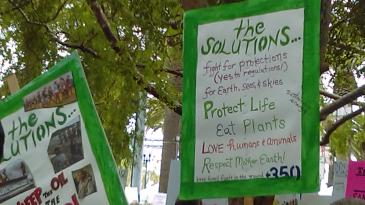
I happily participated in the March for Science with my local Sunday Assembly community, and was heartened to see several, well worn, yellow "Standing on the Side of Love" t-shirts throughout the crowd. The East Bay Atheists, the Kol Hadash Humanistic Jewish Community, the Center for Inquiry, and the Bay Area Humanists were also proud and present, as was a big contingent from San Francisco's Grace Cathedral - with big "Grace for All" signs.

While "listening" to speakers before the March (Can you ever really hear them?), one of our Sunday Assembly members recounted a story from the novel Catch 22- a bit macabre - involving the mix up of a catheter and an IV. "It's crazy!" he recounted, "and when I see what's going on, I just want to shout "This is crazy!"

I enjoyed the look of passer-by on the street, almost overwhelmingly either a smile and thumbs up support, or blissful avoidance.
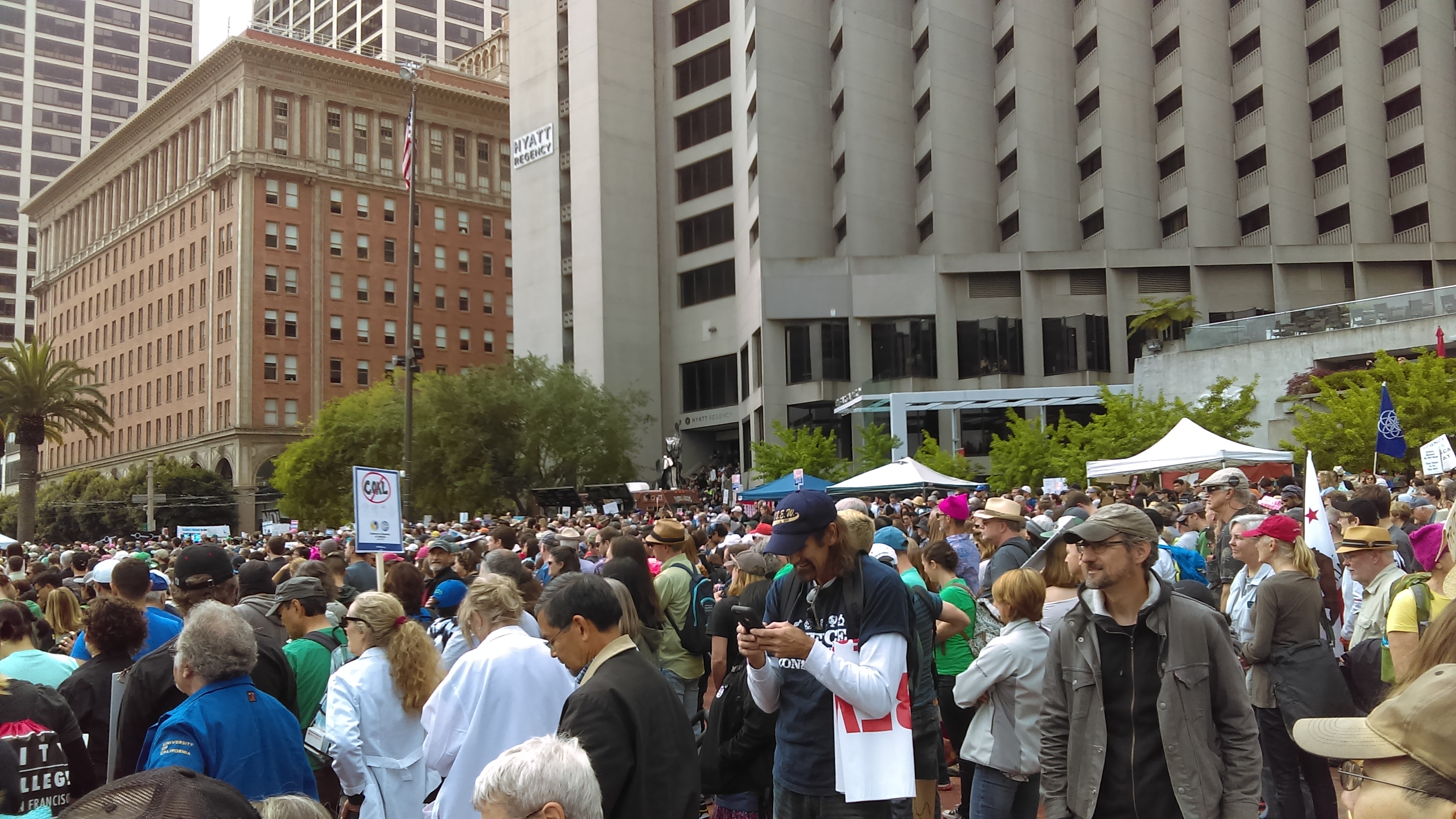
One in our group remarked, "I always don't feel like going to these things the morning of, but when I make myself go, I'm always so glad I did."

I want to carry that resilience with me in the days ahead. That can-do-ism, even when we don't always want to in the short term, can create bigger, more positive results for all us. Our small and mighty humanist communities here in the US are potential life lines and allies to these secular justice seekers and advocates for rational policy, not just here in the US, but overseas.

Initiatives like Secular Rescue assist humanists in exile from violent circumstances in their home countries, and could easily be a recipient of revenue from a potluck fundraiser or "Share the Plate" collection. There may be initiatives through the UUA or UUSC to support atheists and humanists in danger overseas, though I'm not sure what they are.

As Unitarian Universalists and Humanists, we showed up for the March for Science, and will continue to show up for evidence-based policies. Let's show up and support our humanist sisters and brothers overseas - some face death for simply raising questions.

Daniel Lawlor
San Francisco, CA

 

Categories: 

The Unitarian Universalist Association Becomes a March for Science Partner

The UU Humanist Association is very proud that the Unitarian Universalist Association has signed on as a March for Science partner, and is also mobilizing UUs to participate in the People's Climate March which will be held a week later, on April 29. The March for Science is a international movement, planning the main march in Washington DC, for Earth Day, April 22, 2017, as well as over 300 satellite marches around the world. As the March for Science website states,

The March for Science demonstrates our passion for science and sounds a call to support and safeguard the scientific community.

It is time for people who support scientific research and evidence-based policies to take a public stand and be counted.

One of the six sources for Unitarian Universalism is, "Humanist teachings which counsel us to heed the guidance of reason and the results of science," and the UUA has never wavered in its support.

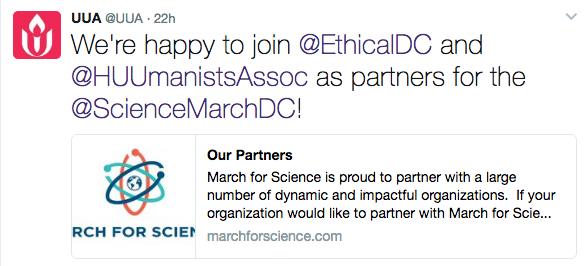
As the UUA's announcement stated, "The UUA is currently the only religious denomination who has partnered with the march." Of course, as shown in the Tweet below, the UUA also recognizes that the American Ethical Union, an association of Humanist congregations, has also partnered with the March.

In addition, the Secular Coalition for America, of which the UUHA is a member organization as is the Society for Humanistic Judaism, is also a March for Science partner.

The UU Humanist Association strongly encourages our local groups and UU congregations to get involved in organizing local contingents of marchers and to volunteer at the marches themselves.

If you are marching on April 22, please share pictures on social media using the tags #ScienceMarch, @UUA, and @UUHumanistAssoc.

Categories: 

Dedication of “Ribbons Not Walls” display at Brevard UU Church, April 2, 2017

“Ribbons” consists of twenty four fabric art panels from over 40 artists around the country. Some are based on themes or cover art from books by Hispanic authors; others directly represent aspects of the immigrant experience.  “Ribbons” was displayed at the UUA General Assemblies in Louisville, KY (2013), Providence, RI (2014), Portland, OR (2015) and Columbus, OH (2016).  In between, panels have traveled to over 60 venues (UU congregations, Humanist meetings, art galleries, etc), and have been viewed by over 14,000 people.  More than 200 individuals (mostly UUs and humanists) have been involved in the  fabrication, curation, display and financial sponsorship of the exhibit.

Following four years on the road, and the wear and tear of being repeatedly set up and taken down, “Ribbons” is transitioning to permanent sites around the country.  These four panels are now on display at the Brevard UU Church, 2185 Meadowlane Ave, West Melbourne, FL  32904: 

Ribbons! Not Walls!                                                  

Artist:  Barbara Kurtz, Friendship Fellowship (UU),  Rockledge, FL
Theme:  The living connections that make us one world, one people.
Medium: Silk clothing remnants.


Like Water for Chocolate

Artist: Nicole Smith, Art Major, Alfred University, NY.
Theme:  Laura Esquival’s novel about Tita, a woman whose emotions impact others through her food.
Medium: Fabric collage and ink drawing.


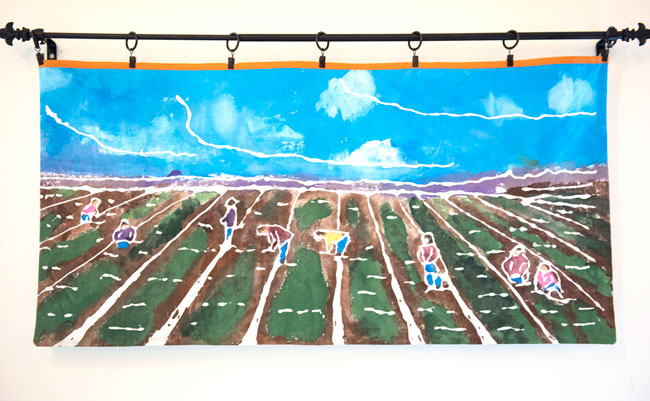
Migrant Field Workers
Artists:  Navigators USA chapter (ages 5-14) at Countryside Church, UU, Palatine, IL.
heme:  Harsh working conditions and low pay put affordable food on our tables.
Medium:  “kid-friendly” batik process with washable glue and permanent acrylic paint.


Burning …
Artist:  Rev. Kendyl Gibbons, All Souls UU Church, Kansas City, MO.
Theme:  Anonymous volumes honor those who have suffered for what they have written.
Medium: Piece work quilting.    

Ribbons Not Walls is sponsored by the Unitarian Universalist Humanist Association.   It was inspired by another UUHA social justice project, “Banned Books by Hispanic Authors,” which collected over 400 copies of books removed from Tucson classrooms when Arizona outlawed the teaching of “Ethnic Studies” in public Schools. These were displayed at the UU General Assembly in Phoenix in 2012, then donated to Puente, a local community organizing group.  Similar local libraries were established at Hispanic Community Centers in Louisville, Tucson and El Paso.

Ribbons Not Walls is curated by Roger and Katherine Brewin, 10559 S Wood St.  Chicago, IL 60643.   Contact them at 773 551 8540 or rabrewin@aol.com.  Thanks to Jim Morison for this installation.

Unitarian Universalist Humanist Association


The letter to UU Church of Brevard:


Ted Hicks, President
Unitarian Universalist Church of Brevard
2185 Meadowlane Avenue
Melbourne, FL 32904

April 2, 2017

Dear Ted:

On behalf of the Board and staff of the UU Humanist Association, we are pleased to transfer custody of four fabric art panels from the UUHA immigration project, Ribbons Not Walls, to the UU Church of Brevard for permanent display. 

These works by artists Kendyl Gibbons, Barbara Kurtz, Nicole Smith and the UU youth of the Navigator Scouts chapter in Palatine, IL are part of a larger collection that has utilized art to carry a message of welcome and inclusion to audiences around the country.  We are delighted that they will now help welcome members and visitors alike to UUCB,  and will remind all who enjoy them here, of the highest values of both Humanism and Unitarian Universalism.     

Si, Se Puede,

Roger and Katherine Brewin, Curators

Ribbons Not Walls,  UU Humanist Association

Categories: 

Unitarian Universalist Humanists And The Interdependent Web of All Existence

[Editor's note: this post was originally published on Adam Gonnerman's Tumblr.]


“We all have a thirst for wonder. It’s a deeply human quality. Science and religion are both bound up with it. What I’m saying is, you don’t have to make stories up, you don’t have to exaggerate. There’s wonder and awe enough in the real world. Nature’s a lot better at inventing wonders than we are.” - Carl Sagan 

Unitarian Universalism is big on social justice. Although some congregations appear to be more keen than others on getting involved in the issues of the day, in general this is a religious group that cares about equality, inclusion, and justice. Contemporary Humanism seems to be headed in much the same direction, with more and more social activism. A key difference may be that while Unitarian Universalists tend to accept the scientific method, it doesn’t seem to receive the same amount of attention that Humanists give it. In fact, to many Unitarian Universalist Humanists it looks like the denomination as a whole is moving towards more ‘spirituality’ and less reason. Herein we find something that I believe can be a key distinguishing contribution that UU Humanists can make to the ‘Living Tradition.’

Before anything else, let me defend my statement above about spirituality and reason. I am not saying that UUs are becoming less reasonable, although I wonder how many buy into the rhetoric against such advances as GMOs. Rather, I’m talking about a diminished public appreciation for science and reason, replaced by ‘the language of reverence.’ Part of this is understandable, as I’ve heard disparaging remarks about a certain variety of UU congregations as being little more than ‘lecture halls.’ 

While 100 years ago people may have sought out lectures to attend, that is certainly not the case today. Services need to be more interactive and artistic to be meaningful to people. Further, shared ritual can help to strengthen the bonds of a community. That said, this doesn’t need to be a pendulum swinging, between some form of spirituality and a more cerebral approach. Equilibrium is possible.

UU Humanists are generally as committed to social justice as UU Christians, Buddhists, Pagans, and those of the various other perspectives. In that we can and should contribute, understanding that there isn’t much unique in what we bring to the table. Yes, we have concepts from the Humanist tradition and manifestos to cite, but this isn’t where we can make the biggest, unique difference.

What should UU Humanists be doing in addition to working for social justice alongside UUs, Humanists, and people beyond these? In my opinion, we should be promoting science and reason in the most interesting, engaging ways possible. This is the sort of thing we see in Sunday Assembly, where people sing along to pop songs and hear talks about social issues, scientific research, and other challenging and thought-provoking topics. Unitarian Universalism has social justice covered; what it needs as well are advocates for understanding the amazing universe of which we are a part.

The story of our universe, our earth, and our evolution is one based on facts – as best we’ve ascertained so far – and has the potential to unify humanity like no other narrative ever could. UU Humanists have a great and awe-inspiring message to convey, one that can be appreciated best with greater understanding of scientific discoveries. In fact, given that Unitarian Universalism is a ‘Living Tradition’ wherein belief is not static and truth is always being pursued, the scientific method fits right in.

What can local UU Humanist groups do? Off the top of my mind, here are a few ideas:

  1. Start a Skeptics in the Pub meetup. This one requires virtually no official involvement on the part of the congregation. Basically, find a pub where your group can meet, promote this in the congregation (coordinating with leadership) and beyond, and get together for drinks and conversation. Each time this group gathers, ideally monthly, there can be a different theme and format. One month there could be a guest who is an expert in some field of science. She can give a talk and take questions. Another month a group member could lead a discussion around a topic of interest in terms of Skepticism, science, reason, etc. Another month could be a games night. The point is to keep it lively and stimulating.
  2. Start an RE Class. Depending on the size of your group and the cooperation of your UU congregation, you could offer to organize the curriculum and provide teachers for an RE class, preferably for children, in which science is taught in a fun way. There can be experiments, videos, and whatever else that will keep the kids’ attention and communicate core science concepts.
  3. Sponsor a science fair. If the RE class is a success, or even if you don’t do the RE class but have sufficient support in the congregation, your local UU Humanists group could arrange a congregational science fair. Set some standards, schedule a science fair night (complete with snacks and a brief talk to kick things off), and have some judges go around awarding ribbons. Top projects would qualify for trophies, and the judges probably should be from outside the congregation to avoid hurt feelings. If you can bring in 3 or more research scientists, professors of science from a local university, or others working in science-based fields, that would be ideal.
  4. Lead a service. The universe is an amazing place. Organize a liturgy that celebrates that fact, including quotes from the likes of Carl Sagan and Neil Degrasse Tyson as well as a positive, captivating talk centered on the known facts of this one life we know exists. There can be a Humanistic chalice lighting and responsive readings as well. Be creative.

Those are just a few possibilities. If you think UU Humanists could be doing more to promote a rational approach to understanding the interdependent web of all existence, what other ways would you suggest we go about doing it?

Categories: 

A Message from the President

Dear Unitarian Universalist Humanists:

Your UU Humanist Association has been working to promote humanist values in the UUA. Working with UUA President Peter Morales and UUA Chief Operating Officer Harlan Limpert, we have been pressuring the Boy Scouts of America to exhibit progressive values. In an abrupt change in direction, the BSA now accepts all those who identify as boys. Unfortunately, the BSA has not budged on their discriminatory policy toward non-theists. We will continuing working to change this policy. We have over 1600 signatures on our BSA petition!

Have you seen the UU World article on Humanism at 100? I think the article underlines the fact that Humanism has continued to spread and change both within and outside its Unitarian Universalist context.

Will you be attending the UUA General Assembly June 21-25 in New Orleans? The theme is “Resist and Renew.” UU Humanist Association Vice President Amanda Poppei and I are really looking forward to modeling our take on a Humanist Assembly, and sharing that with those gathered at GA!

Also at General Assembly join us for our Annual Meeting on Friday evening, June 23rd. We will recognize the incredible contribution to humanism made by William R. Murray—one of the most influential humanists in Unitarian Universalism—with our Lifetime Achievement Award. Our Humanist of the Year Award will go to humanist theologian Dr. Anthony Pinn. Don’t miss this exciting gathering. 

Much is also happening in the larger humanist world. In April there will be a gathering of the Humanist Collaboratory at Washington Ethical Society in Washington, D.C. This will be a gathering of humanists working in congregational contexts, including representatives from Unitarian Universalism, Ethical Culture, and Humanistic Judaism.

In other news, Chris Stedman, currently the Humanist Chaplain at Yale, will be moving to Minneapolis in the autumn to found a Humanist Center in conjunction with First Unitarian Society, the Humanist Institute, and Augsburg, College among other partners. The Humanist Center will pull together congregational humanists, secular humanists, atheists, and “nones” to form a new way for non-theists to join in community.

Your UU Humanist Association will continue to advocate for Humanism in the UUA and the larger world. We will continue to advocate for that wall of separation between church and state and for the freedom of and from religion. If you know of others who might benefit from the UU Humanist Association, please share the good news.

The philosopher of science Karl Popper wrote, “We are social creatures to the inmost center of our being. The notion that one can begin anything at all from scratch, free from the past, or unindebted to others, could not conceivably be more wrong.”

In this spirit we continue to work for reason, compassion, and community.

Rev. Dr. David Breeden

Categories: 

Pages

Subscribe to Front page feed